
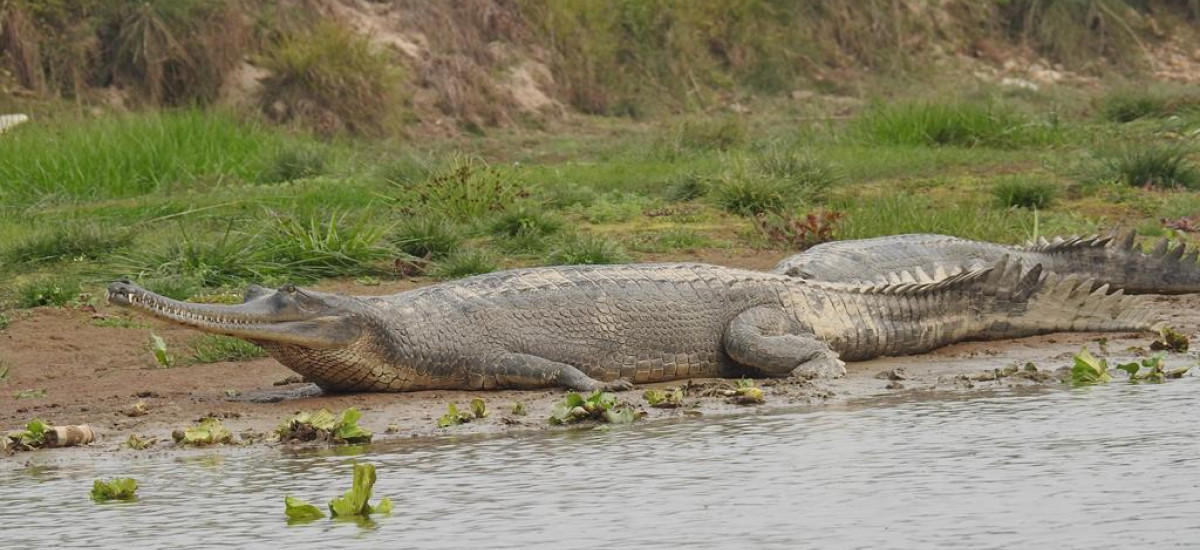
The gharial (Gavialis gangeticus) and mugger (Crocodylus palustris) crocodile species of Nepal are among two of the 24 crocodile species found in the world. But their habitats have become increasingly threatened, mostly as a result of pressures from river-dependent communities. Gharial are critically endangered species and are only found in Nepal and India. In Nepal they have become restricted to the rivers of Chitwan National Park (CNP) and Bardia National Park (BNP).
In order to ensure a sustainable future for these critically endangered species, NTNC works with the related park authorities and local communities of CNP and BNP to conserve gharials while providing better alternatives for river dependent communities.
To understand the existing status of gharial and mugger numbers, a team from NTNC-BCC completed the annual gharial monitoring, counting a total of 230 gharials and 136 mugger crocodiles. During the exercise, the two main rivers of CNP—Rapti and Narayani—were divided into 13 segments with monitoring being carried out for three consecutive days by 13 teams. The teams counted 113 gharials and 92 muggers from Rapti river systems, and 117 gharials and 44 muggers from Narayani. Further west from CNP, in Bardia the monitoring exercise was primarily based in the Karnali and Babai River systems that flow alongside Bardia National Park and its buffer zone.
In addition to establishing the current status of crocodiles in each of the associated river systems, their habitat suitability and anthropogenic disturbance associated with both the species was also studied. In turn, all these will help to better understand crocodile ecology and their population status and thus inform future conservation strategies accordingly.
Besides the annual monitoring of the crocodiles, batches of gharials are periodically released from the Gharial Breeding Centre in Chitwan National Park. In this way, breeding, release and monitoring exercises, along with community initiatives, all are undertaken together to push for the conservation and revitalization of these highly endangered and sensitive reptiles.


